
Maryland
Maryland E-Bike Laws
Maryland defines electric bicycles in Transportation Article § 11-117.1 using the standard three-class system effective since 2020 legislation. Class 1 e-bikes provide pedal-assist up to 20 mph, Class 2 e-bikes may use a throttle up to 20 mph, and Class 3 e-bikes provide pedal-assist up to 28 mph with a mandatory speedometer. All classes require operable pedals, two or three wheels, and a motor rated at 750 watts or less. Compliant e-bikes are treated like bicycles for most road purposes and do not require registration, titling, or a driver's license. Manufacturers must affix permanent class labels, and riders may not tamper with motor capability without updating the label. Operation rules in § 21-1205.2 establish Maryland's distinctive trail policy: Class 1 and Class 2 e-bikes may travel wherever bicycles are allowed, including bike lanes, but a local authority or state agency with jurisdiction over a bicycle path may prohibit Class 1 or Class 2 on that path. Class 3 e-bikes face a stricter default ban on bicycle paths unless the path is within or adjacent to a highway right-of-way or the controlling agency expressly allows Class 3. Natural-surface nonmotorized trails may be regulated for any class. Age rules are also class-specific: no one under 16 may operate a Class 3 e-bike on a public highway, though younger passengers may ride on Class 3 bikes designed to carry them. Helmet law applies broadly to bicycles: § 21-1207.1 requires anyone under 16 riding a bicycle—including e-bikes treated as bicycles—to wear an ANSI, Snell, or ASTM compliant helmet on highways, bicycle ways, and other public property, enforced through warnings and education rather than fines in most cases. A major 2025 update, House Bill 375 (Jay's Law, effective October 1, 2025), changed sidewalk policy statewide: unless a local ordinance prohibits it, people may ride bicycles, play vehicles, and unicycles on sidewalks and must yield to pedestrians and users of electric personal assistive mobility devices when doing so. Local business districts such as Baltimore may still restrict sidewalk cycling by ordinance. Devices exceeding class limits or modified beyond labeled capability may be reclassified as mopeds or motor scooters with additional requirements.
By eBikeQuest Editorial Team · Platform Research & Verification
Reviewed by eBikeQuest Editorial Team · Internal verification and editorial review
- Published:
- June 1, 2026
- Updated:
- June 18, 2026
- Reviewed:
- June 1, 2026
- Policy verified:
- June 18, 2026
Related regulatory guides
Summary
Maryland defines electric bicycles in Transportation Article § 11-117.1 using the standard three-class system effective since 2020 legislation. Class 1 e-bikes provide pedal-assist up to 20 mph, Class 2 e-bikes may use a throttle up to 20 mph, and Class 3 e-bikes provide pedal-assist up to 28 mph with a mandatory speedometer. All classes require operable pedals, two or three wheels, and a motor rated at 750 watts or less. Compliant e-bikes are treated like bicycles for most road purposes and do not require registration, titling, or a driver's license. Manufacturers must affix permanent class labels, and riders may not tamper with motor capability without updating the label. Operation rules in § 21-1205.2 establish Maryland's distinctive trail policy: Class 1 and Class 2 e-bikes may travel wherever bicycles are allowed, including bike lanes, but a local authority or state agency with jurisdiction over a bicycle path may prohibit Class 1 or Class 2 on that path. Class 3 e-bikes face a stricter default ban on bicycle paths unless the path is within or adjacent to a highway right-of-way or the controlling agency expressly allows Class 3. Natural-surface nonmotorized trails may be regulated for any class. Age rules are also class-specific: no one under 16 may operate a Class 3 e-bike on a public highway, though younger passengers may ride on Class 3 bikes designed to carry them. Helmet law applies broadly to bicycles: § 21-1207.1 requires anyone under 16 riding a bicycle—including e-bikes treated as bicycles—to wear an ANSI, Snell, or ASTM compliant helmet on highways, bicycle ways, and other public property, enforced through warnings and education rather than fines in most cases. A major 2025 update, House Bill 375 (Jay's Law, effective October 1, 2025), changed sidewalk policy statewide: unless a local ordinance prohibits it, people may ride bicycles, play vehicles, and unicycles on sidewalks and must yield to pedestrians and users of electric personal assistive mobility devices when doing so. Local business districts such as Baltimore may still restrict sidewalk cycling by ordinance. Devices exceeding class limits or modified beyond labeled capability may be reclassified as mopeds or motor scooters with additional requirements.
Classifications
Class 1
Pedal-assist only; motor ceases at 20 mph; up to 750 watts; permanent class label required since January 1, 2020.
- Roads
- Allowed
- Trails
- Allowed where bicycles may travel, but path managers may prohibit Class 1 on specific bicycle paths under § 21-1205.2(a)(2)(i).
- Max assist
- 20 mph
Class 2
Motor assists whether or not the rider pedals; ceases at 20 mph; up to 750 watts; permanent class label required.
- Roads
- Allowed
- Trails
- Same as Class 1: permitted on bike lanes and most roads, but individual bicycle paths may ban Class 2 by agency action.
- Max assist
- 20 mph
Class 3
Pedal-assist only; motor ceases at 28 mph; up to 750 watts; must include a speedometer and permanent class label.
- Roads
- Allowed
- Trails
- Prohibited on bicycle paths unless the path is within or adjacent to a highway right-of-way or expressly authorized by the path manager.
- Max assist
- 28 mph
Trail access
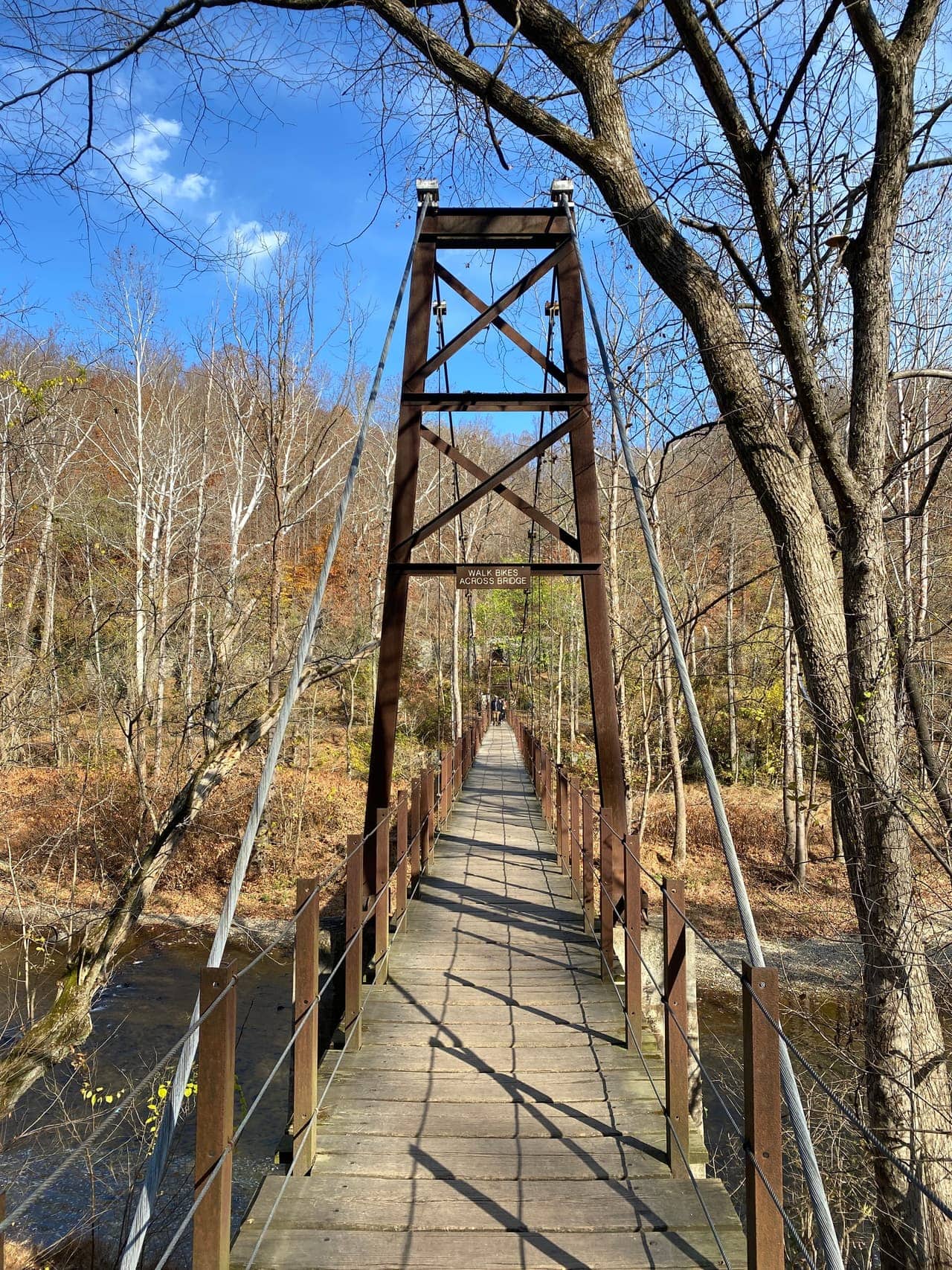
Maryland's e-bike trail access rules under § 21-1205.2 create one of the region's clearest class distinctions. By default, all three classes may be operated wherever conventional bicycles may travel, including public roads and bike lanes. That default, however, narrows quickly on off-road infrastructure. Any local authority or state agency that controls a bicycle path may prohibit Class 1 or Class 2 e-bikes on that path without needing a statewide waiver. Class 3 e-bikes are treated more restrictively: they may not be ridden on a bicycle path at all unless the path sits within or next to a highway right-of-way or the responsible agency has explicitly opened the path to Class 3. In practice, this means many rail-trails, park paths, and greenway connectors that qualify as bicycle paths prohibit Class 3 unless posted otherwise, while Class 1 and Class 2 remain allowed until a manager opts out. For natural-surface trails designated nonmotorized—with a tread formed by clearing and grading native soil without added surfacing—agencies may regulate e-bikes of any class. Popular systems such as the B&A Trail, MA & PA Trail, and Montgomery County park paths each publish supplemental rules; riders should verify the managing body. Federal lands in Maryland follow separate policies. On sidewalks, HB 375 (effective October 1, 2025) establishes a statewide permission for bicycle riding on sidewalks unless a local ordinance bans it, with a mandatory yield to pedestrians and EPAMD users. Baltimore City and other municipalities may still restrict sidewalk cycling in business districts. Helmet requirements for riders under 16 apply on bicycle ways and public property, reinforcing safety expectations on multi-use paths. When choosing a route, match your bike's class label to both the statutory path restrictions and any posted trail-specific rules.
Requirements
- Required for all bicycle riders and passengers under 16 on public roads, bicycle ways, and public property under § 21-1207.1.
- Class 3 operators must be at least 16 on public highways; younger passengers may ride on Class 3 bikes designed for passengers.
- Not required
- Not required
FAQ
Yes. Maryland recognizes Class 1, Class 2, and Class 3 electric bicycles under § 11-117.1 when they meet wattage, speed, labeling, and equipment standards.
Sources
- Maryland Transportation Code § 11-117.1 – Electric bicycle definitions (opens in new tab) (accessed 2026-06-18)
- Maryland Transportation Code § 21-1205.2 – Operation of electric bicycles (opens in new tab) (accessed 2026-06-18)
- Maryland Transportation Code § 21-1207.1 – Bicycle helmets required (opens in new tab) (accessed 2026-06-18)
- Maryland HB 375 (2025) – Sidewalk bicycle riding (Jay's Law) (opens in new tab) (accessed 2026-06-18)